The Nexus: How Exclusion Drives Hunger
Why, in this technologically advanced world, are some 700 million people — nearly ten percent of all humanity — perpetually hungry? Who are they? Where are they? Why are they? Is there enough food? Is it a distribution problem, getting fresh, clean food where it’s needed? Is it an infrastructure problem? Is it a political problem? What are the primary causes, and what are the feasible solutions that don’t depend on everyone in the world deciding to play “nice,” suddenly? This essay explores the causes and the solutions. And yes, it is solvable.
Readers: Please visit NEXcf.com to explore more about how you can participate in the social impact imperative to overcome the twin perils of hunger and financial exclusion.
Current Status and Profile of the Chronically Hungry
The perpetually hungry are those who consistently consume less than the minimum required dietary energy for a normal, active, and healthy life. This condition, often termed undernourishment, means they lack regular access to safe and nutritious food.
Who and Where Are They?
- Who: The majority are the rural poor, often small-scale farmers or those in marginalized communities, including a disproportionate number of women and children. Malnutrition contributes to nearly half of all deaths in children under five.
Where: The greatest concentration of hunger is in Africa (particularly Sub-Saharan Africa, which accounts for more than half the world’s undernourished people) and Western Asia. Countries and regions affected by prolonged conflict or severe or prolonged seasonal instability—such as Sudan, Yemen, the Democratic Republic of the Congo, and parts of the Horn of Africa—often contain the highest numbers of people facing acute food insecurity and famine-like conditions.
Is There Enough Food?
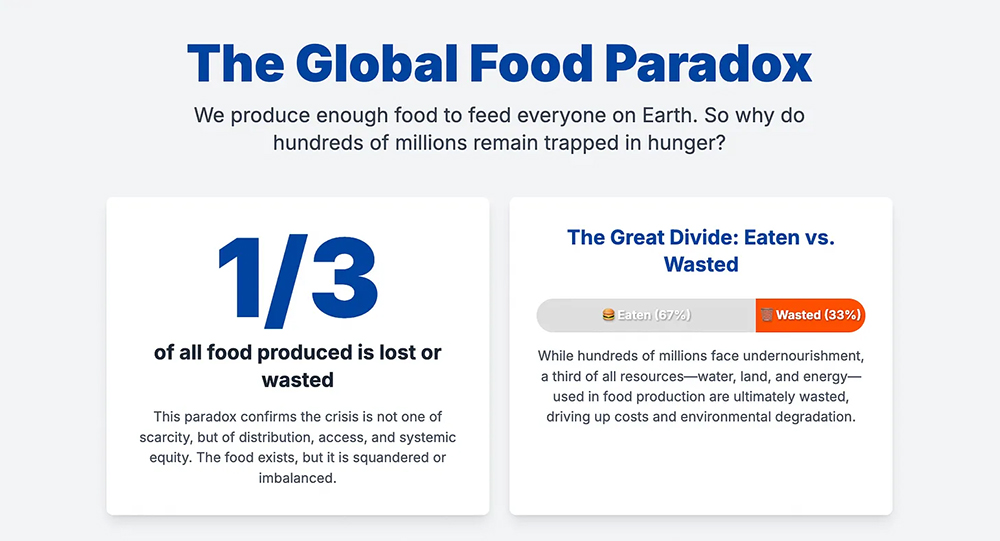
Unequivocally, yes, there is enough food. The world produces more than enough food to feed the entire global population of over 8 billion people. According to the UN, one-third of all food produced (about 1.3 billion tons) is lost or wasted annually, which is enough to feed approximately twice the number of chronically hungry people. The problem is not a lack of production but a failure of access and sustainability.
The Primary Causes: A Complex Web
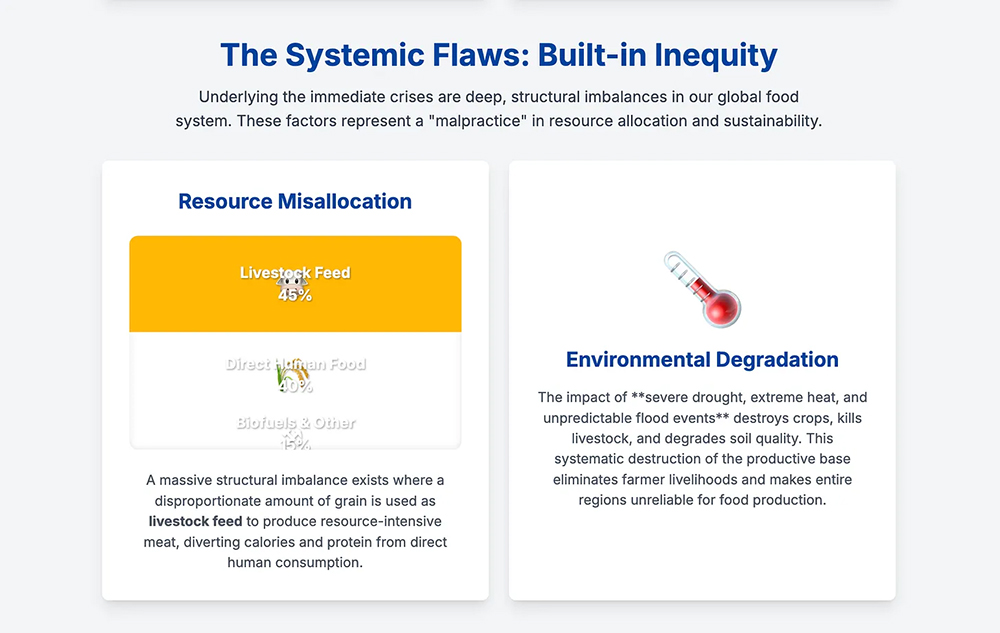
The persistence of hunger is not due to a single failure but a convergence of structural, environmental, and political issues. The problem is a mix of distribution, infrastructure, and political failure.
1. Conflict and Political Instability (The Primary Driver)
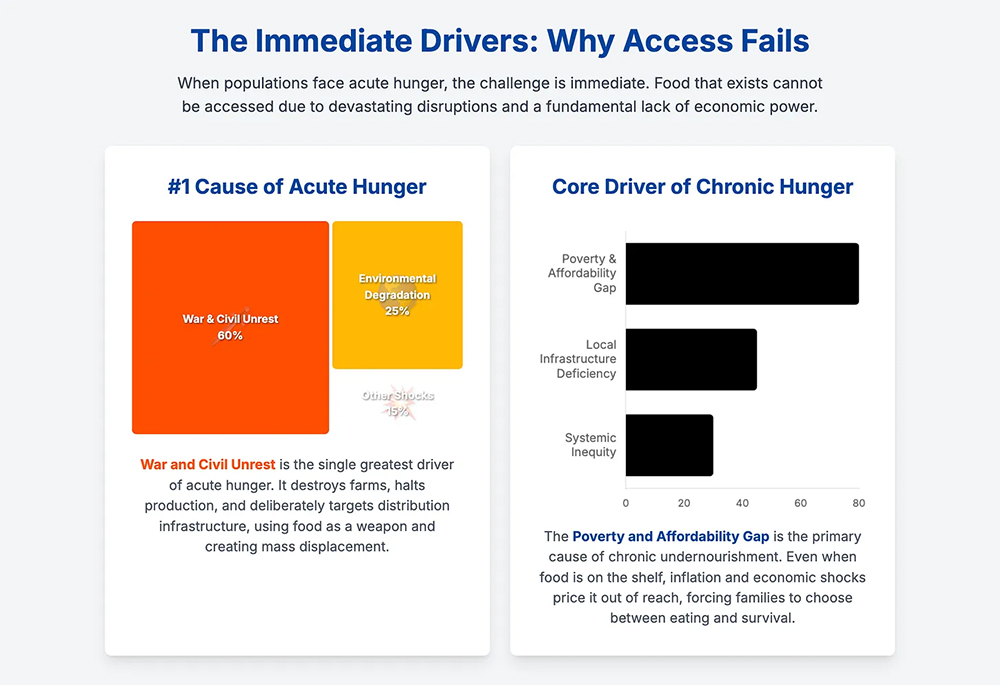
Conflict is the single largest driver of acute hunger. War and political violence destroy farmlands, livestock, and critical infrastructure like roads, markets, and water sources. Conflict also causes massive displacement of populations, cutting people off from their livelihoods and making the delivery of humanitarian aid extremely difficult, often resulting in food being used as a weapon of war.
2. Floods, Drought and Other Environmental Shocks
Increasingly frequent and severe droughts, floods, and extreme weather events devastate agricultural land, reduce crop yields, and destroy harvests, pushing vulnerable populations—who rely heavily on rain-fed subsistence farming—into chronic food insecurity, intensifying other causes of hunger.
3. Structural Poverty and Economic Inequality
Deep-rooted poverty is a fundamental cause. Even when food is physically available, a significant portion of the global population cannot afford a healthy, nutritious diet due to low incomes, unemployment, and lack of social safety nets. Global and regional economic shocks and inflation (especially rising food and fuel prices) further erode purchasing power, hitting the poor the hardest.
4. Infrastructure and Distribution Problems (Not the Only Problem)
While not the sole cause, poor infrastructure contributes significantly. A lack of proper roads, storage facilities, refrigeration, and reliable energy in developing regions leads to high rates of post-harvest food loss. Furthermore, complex supply chains and long distances can make fresh, clean food unaffordable or inaccessible in remote areas.
5. Weak Governance and Policy Failures
Political problems are central. This includes corruption, lack of investment in rural agriculture and public services, and policy choices that prioritize cash crops for export over local food security. Unstable governments often lack the political will or capacity to implement effective, equitable food distribution and social protection programs.
Geographic Distribution of Chronic Hunger
The world is currently grappling with two interconnected hunger crises: chronic undernourishment, which affects over 700 million people globally (roughly one in nine individuals) and represents sustained, long-term hunger, and acute food insecurity, the life-threatening extreme affecting over 319 million people primarily in conflict zones. The most severe of these acute crises, often driven by violence and economic collapse, are concentrated in a few key hotspots. The Democratic Republic of Congo (DRC), while not facing confirmed famine like other areas, accounts for the largest affected population, with approximately 28 million Congolese dealing with high levels of food insecurity. Meanwhile, several nations are pushed to the absolute brink: Sudan is in a catastrophic state, with famine confirmed in certain displacement camps, alongside a conflict that has displaced over 11.3 million people and cut off access to aid. Furthermore, the crisis in Haiti means that one in every two Haitians faces hunger, with nearly 2 million people projected to reach emergency food insecurity levels by mid-2025. Finally, the prolonged emergency in South Sudan affects over 7.7 million people—more than half the population—with 2.3 million children specifically struggling with acute malnutrition, demonstrating the devastating intensity of these most critical regional crises.
The Primary Causes: A Complex Web
The problem is a mix of distribution, infrastructure, and, most critically, political failure.
- Conflict and Political Instability (The Primary Driver): War destroys farms, disrupts supply chains, and uses food as a weapon, leading to mass displacement. Nearly 70% of people facing acute hunger live in conflict-affected areas.
- Droughts, Floods, and Other Environmental Shocks: Severe droughts, floods, and extreme weather devastate crops, pushing vulnerable subsistence farmers—especially in Africa and Asia—into chronic food insecurity.
- Structural Poverty and Economic Inequality: Poverty is the fundamental barrier. Food may be physically available, but billions cannot afford a nutritious diet. Global economic shocks and inflation erode purchasing power, hitting the poorest the hardest.
- Infrastructure and Post-Harvest Loss: Lack of proper roads, refrigerated storage, and processing facilities leads to high rates of food loss (up to 40% in some developing nations) before food ever reaches a consumer.
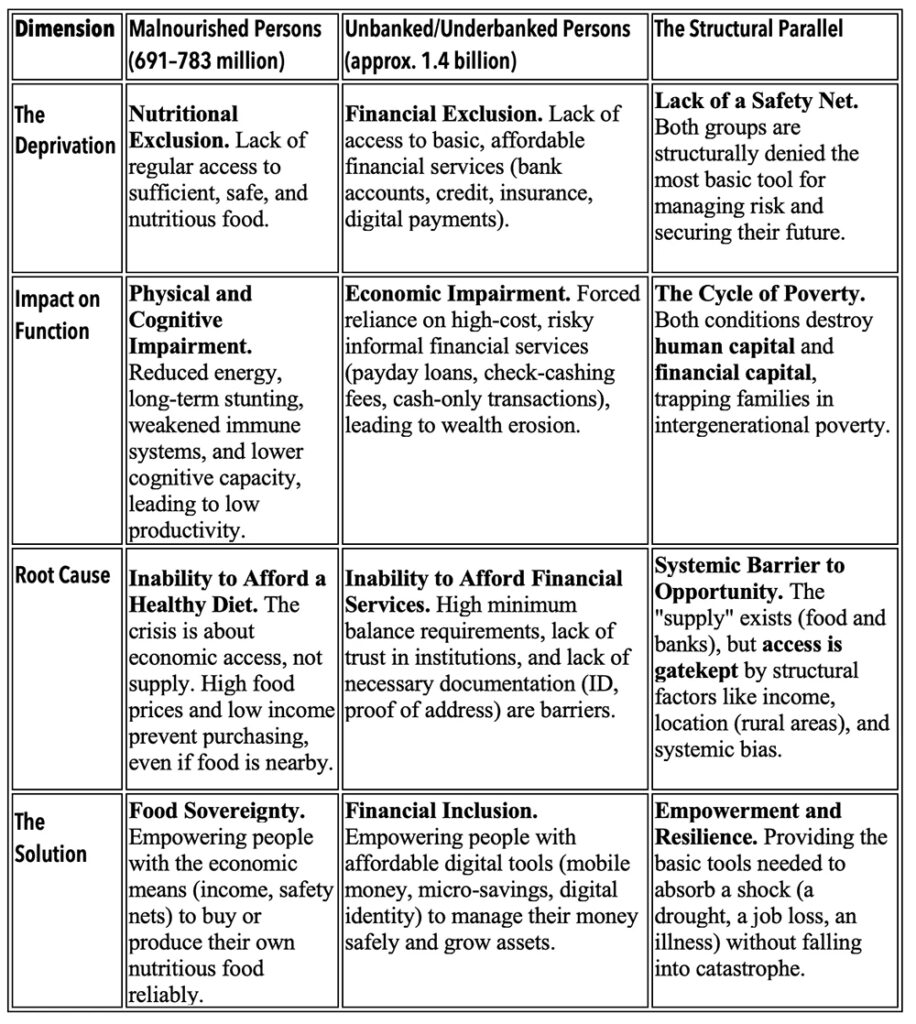
The Nexus: How Exclusion Drives Hunger
The unbanked/underbanked population is estimated to be over 1.4 billion people globally, and the regions with the highest concentration of the unbanked heavily overlap with those facing the highest rates of chronic hunger (e.g., Sub-Saharan Africa and South Asia). Financial exclusion directly exacerbates food insecurity in three critical ways:
- Vulnerability to Shocks: A farmer who is unbanked has no formal savings account or crop insurance. When a drought hits, they have no buffer and must immediately sell off their productive assets (livestock, tools) or take a high-interest loan to feed their family. This destroys their capacity for the next planting season, creating a cycle of destitution and hunger.
- Inefficiency and Leakage: The unbanked lose a significant portion of their already meager income to high-cost alternative financial services. They pay fees to cash their government or paycheck, pay a premium on cash-based purchases, and cannot easily make digital payments to access better market prices. This leakage of essential income directly reduces the money available to buy nutritious food.
- Inability to Access Safety Nets: Governments and NGOs increasingly distribute aid (like food stamps or emergency cash transfers) through digital platforms or bank accounts. Being unbanked becomes a barrier to receiving aid, denying the most vulnerable their last line of defense against starvation.
In short, financial exclusion is a form of economic malnutrition. It starves a person’s ability to save, invest, manage risk, and ultimately, afford the food that would end their physical malnutrition.
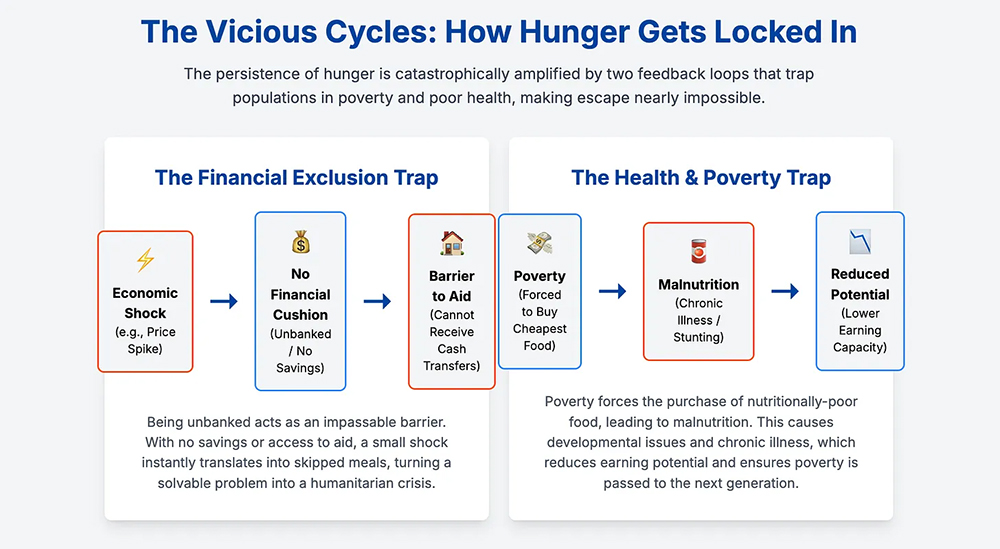
The Interlocking Crises of Hunger and Exclusion
The paradox of global hunger—enough food for all, yet hundreds of millions malnourished—is best understood as a crisis amplified by two critical, interlocking feedback loops:
1. The Force Multiplier of Financial Exclusion
The problem of being unbanked or underbanked acts as a powerful force multiplier on the distribution and affordability crisis.
When food is available but prices spike due to global supply disruptions (war, climate), financially excluded populations are the most vulnerable because:
- Zero Financial Cushion: They lack formal savings, credit, or insurance to absorb the shock of high prices. A small price increase immediately translates into skipped meals.
- Inefficient Transactions: They are forced to rely on cash or expensive, informal systems. Receiving remittances (a lifeline for many) often involves high fees and delays, reducing the real purchasing power of the money intended to buy food.
- Hindered Aid Delivery: When a crisis demands an immediate humanitarian response, cash transfers—the most efficient form of aid—are bottlenecked or impossible to deliver to populations without a digital payment system or bank account.
In essence, being unbanked makes the existing distribution and affordability problems exponentially worse, converting food scarcity into immediate starvation.
2. The Vicious Cycle of Poverty and Health
The linked effect of poverty and poor health creates a vicious cycle that traps the poor, even in areas where food availability is ostensibly sufficient. This goes beyond simple calorie intake:
- Poverty → Poor Health: Low-income families are forced to purchase the cheapest, most energy-dense, but nutritionally-poor foods (often highly processed starches). This leads to malnutrition, which is a lack of nutrients (vitamins, protein, micronutrients), not just calories.
- Poor Health → Poverty: Malnutrition, coupled with poor sanitation and limited access to healthcare (another service inaccessible to the unbanked), results in poorer health and cognitive development from an early age. This, in turn, reduces an individual’s physical capacity for labor, educational attainment, and lifetime earning potential, making it harder to escape poverty.
Therefore, the affordability crisis translates not just into short-term hunger, but into long-term, debilitating illness that guarantees the transmission of poverty across generations. The high cost of nutritious food and health services effectively prices the poor out of their own well-being and economic future.
The Direct Correlation Between Gradual Financial Momentum and Health Outcomes
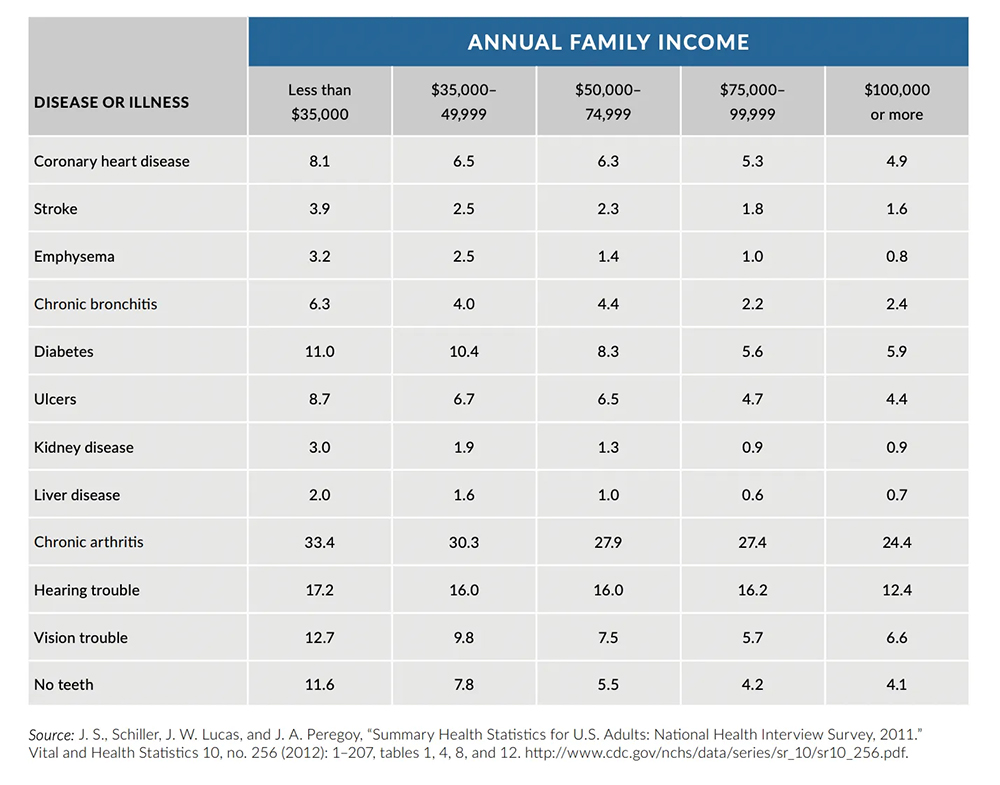
There is a startling and meaningful correlation between poverty and poor health — a steady increase of income or buying power steadily uplifts health outcomes, according to the researchers who compiled the above cited study.
Among their conclusions: “The relationship between income and health is a gradient: they are connected stepwise at every level of the economic ladder. Although Blacks and Hispanics have higher rates of disease than non-Hispanic whites, these differences are “dwarfed by the disparities identified between high- and low-income populations within each racial / ethnic group.” That is, higher-income Blacks, Hispanics, and Native Americans have better health than members of their groups with less income, and this income gradient is more strongly tied to health than race or ethnicity.”
In other words, every step upwards on the income or financial momentum ladder has a correlated effect towards increased health and reduced disease.1
It is the conclusion of the authors that the steady eradication of poverty and hunger — in unison — are inseparable twins in the planet’s unending battle — individual, institutional, and government agency efforts — to foster the most fertile conditions to enable widespread human flourishing. §
It is the conclusion of the authors that the steady eradication of poverty and hunger — in unison — are inseparable twins in the planet’s unending battle — individual, institutional, and government agency efforts — to foster the most fertile conditions to enable widespread human flourishing.

Sources
Global Hunger & Food Security Sources
- The State of Food Security and Nutrition in the World (SOFI) Report (FAO, IFAD, UNICEF, WFP, WHO):
- Viability & Accuracy: This is the flagship annual report produced collaboratively by five UN agencies. It provides the definitive, official statistics on the prevalence of undernourishment (PoU), moderate and severe food insecurity, and child malnutrition indicators globally and regionally.
- World Food Programme (WFP) – Data and Maps:
- Viability & Accuracy: As a leading humanitarian organization, WFP provides real-time, acute food insecurity data and analysis, especially for conflict and disaster zones. Their data is critical for understanding immediate, acute hunger crises.
- Global Hunger Index (GHI):
- Viability & Accuracy: An annual, peer-reviewed report that comprehensively measures and tracks hunger using four indicators: undernourishment, child wasting, child stunting, and child mortality. It offers a structured country-by-country comparison.
- International Food Policy Research Institute (IFPRI):
- Viability & Accuracy: A highly respected non-profit policy research institute that provides research-based policy solutions to sustainably reduce poverty and end hunger and malnutrition. Their Global Food Policy Report is a key source of commentary.
Financial Exclusion & Inclusion Sources
- The Global Findex Database (The World Bank):
- Viability & Accuracy: The world’s most comprehensive demand-side data set on how adults save, borrow, make payments, and manage risk. It is the gold standard for tracking global financial inclusion (account ownership, digital payments, etc.).
- CGAP (Consultative Group to Assist the Poor):
- Viability & Accuracy: A global partnership housed at the World Bank that conducts and publishes influential research on financial inclusion for the poor, often focusing on digital finance, microfinance, and policy recommendations.
- Financial Access Survey (FAS) (International Monetary Fund – IMF):
- Viability & Accuracy: Provides supply-side data (from financial institutions) on access to and use of financial services, complementing the World Bank’s demand-side Global Findex data. It’s essential for a full picture of financial system reach.
- World Bank Poverty and Shared Prosperity Reports:
- Viability & Accuracy: While focusing on poverty reduction, these reports consistently feature analysis linking financial access, inequality, and the ability of the poor to escape extreme poverty, offering high-level commentary and data on the relationship between these issues.
U.S. Domestic Data & Commentary
- U.S. Department of Agriculture (USDA) Economic Research Service (ERS) – Food Security in the U.S.:
- Viability & Accuracy: The official, definitive source for U.S. food insecurity statistics, providing annual data on the prevalence and severity of food insecurity at the national and state level.
- Feeding America – Research & Map the Meal Gap:
- Viability & Accuracy: The largest domestic hunger-relief organization in the U.S. They produce detailed, local-level data (Map the Meal Gap) and commentary on food insecurity, offering a ground-level perspective alongside the official USDA statistics.
These sources, especially the UN and World Bank reports, frequently draw connections between food insecurity and financial access, as both are symptoms of broader economic instability and inequality.
Ten Viable, Localized Solutions to Global Hunger
These solutions focus on empowering local communities and improving food systems without requiring immediate, total global political consensus.
- Promote Climate-Smart Agriculture (CSA): Implement local training on resilient techniques like drought-resistant seeds, water harvesting, agroforestry, and modern methods of enclosed, space efficient, production intensifying, hydroponic facilities; to help farmers adapt to local climate vagaries.
- Invest in Post-Harvest Storage: Provide affordable, low-tech solutions like hermetic storage bags and communal silos to drastically reduce on-farm food loss.
- Support Smallholder Farmer Cooperatives: Establish and strengthen local groups to improve collective bargaining power for supplies, share machinery, and access markets, increasing their income stability.
- Community-Based Malnutrition Treatment (CMAM): Decentralize the diagnosis and treatment of severe malnutrition using Ready-to-Use Therapeutic Food (RUTF) via local clinics and volunteers, ensuring rapid, life-saving care.
- Implement Cash-Based Transfers (CBTs): Provide vulnerable families with direct cash or food vouchers. This is efficient, supports local markets, and gives recipients dignity and choice over what they eat.
- Secure Land and Resource Rights: Formalize land rights, especially for women, as secure tenure is directly linked to greater investment in soil health and higher agricultural output.
- Develop Localized Early Warning Systems: Use simple technology (e.g., mobile apps, text alerts) to give farmers timely, local information about weather, pests, and market prices, allowing them to plan and mitigate risks.
- Prioritize Local Food Procurement: Require governments and aid agencies to buy food for relief and social programs (e.g., school lunches) from local smallholder farmers, creating stable, nearby demand.
- Promote Diversified, Nutritious Diets: Move away from monocultures by encouraging the cultivation and consumption of local, nutrient-dense, indigenous crops that are also more resilient to local climate stress.
- Micro-Finance for Rural Entrepreneurs: Provide small loans and financial training to rural women and youth to start small food processing, transport, or storage businesses, improving local infrastructure and value chains.
- Plus, all the other bigger, better, cleaner, healthier, and nutrient-rich ideas in the minds of young entrepreneurs, engineers, scientists, farmers, builders, and creators.
- Note: the study illustrated above included statistics for the USA only. The authors of this article are prepared to assume that the correlation between income and wellness is general across countries, regions, and ethnicities, but reserve their “certainty” pending additional sources. ↩︎